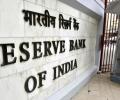
The RBI also looked into the effectiveness of systems and processes for implementation of KYC norms

The fall was led by banking stocks, with IndusInd Bank, Kotak Bank, Federal Bank, Axis Bank, ICICI Bank, HDFC Bank and SBI declining up to 2.36 per cent.
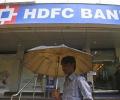
With the merger between HDFC Bank and HDFC Ltd complete, analysts said the next key monitorable for the Street would be successful resolution of merger-related hiccups, including employee-related churn and roll out of complete banking services across branches. At the bourses, they expect the stock to perform in-line with the benchmark indices in the near-term. "There's usually an initial period of consolidation after a merger as the entities work towards integration.

IndusInd Bank was the top gainer in the Sensex pack, spurting over 7 per cent, followed by ITC, SBI, Reliance Industries, Kotak Bank, ICICI Bank and Axis Bank. NSE Nifty surged 110.05 points to its new closing high of 17,629.50.
Fresh hiring might slow as banks likely to focus on improving efficiencies.

Some banks, including ICICI, want to restructure securitised advances along with other loans. This is being opposed by Axis Bank, IndusInd Bank and YES Bank.
Reliance Industries was the top gainer in the Sensex pack, rising over 1 per cent, followed by ICICI Bank, SBI, HDFC, M&M, Axis Bank, Bajaj Finance, Titan and Infosys. NSE Nifty advanced 42.20 points at 15,722.20.

From the Sensex constituents, Tata Steel, Bajaj Finance, Bharti Airtel, Adani Ports, Eternal, Bajaj Finserv, NTPC, HDFC Bank, Reliance Industries and Axis Bank were among the major gainers. In contrast, Trent, State Bank of India, Tech Mahindra, Maruti and Mahindra & Mahindra were among the laggards.

Fund managers say the recent fall is not going to sustain.

SBI was the top loser in the Sensex pack, shedding over 4 per cent, followed by Bajaj Finserv, Axis Bank, ONGC, ITC, ICICI Bank, Bajaj Finance, Kotak Bank and HDFC Bank.
Power Grid, HCL Technologies, Asian Paints, Hindustan Unilever, Maruti and Nestle were among the laggards. Shares of HCL Technologies were trading over 1 per cent lower even after the company reported a 7.6 per cent year-on-year rise in June quarter net profit on the back of new order wins.
Recovering from a two-session carnage, equity benchmark Sensex rebounded 887 points on Tuesday, led by gains in index majors ICICI Bank, HDFC twins and Infosys amid a positive trend in global markets. According to experts, global equity markets are slightly relieved after studies pertaining to the Omicron strain of COVID-19 suggest that even though it is fast spreading, it is largely milder than the Delta variant. The 30-share BSE Sensex ended 886.51 points or 1.56 per cent higher at 57,633.65.

Bajaj Finance was the top laggard in the Sensex pack, tanking up to 8 per cent, followed by M&M, Tata Steel, Bajaj Auto, ONGC, HDFC Bank and Kotak Bank. On the other hand, TCS, Tech Mahindra, HUL, Axis Bank and ITC were the top gainers.
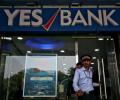
The Yes Bank Reconstruction Scheme 2020, shall come into force on March 13, the gazette notification said.

Finance, ICICI Bank, Mahindra &h Mahindra, Kotak Mahindra Bank and Titan were among the gainers. Bharti Airtel, Adani Ports, Tech Mahindra, Reliance Industries, Axis Bank, Larsen & Toubro were the laggards.

Asian Paints dropped the most by 1.33 per cent. IndusInd bank fell 1.2 per cent, Axis Bank by 1.19 per cent, SBI by 1.12 per cent, Bajaj Finance by 1.07 per cent, Nestle by 1.04 per cent, and TCS by 0.97 per cent. Hindustan Unilever, Reliance Industries, Power Grid and Kotak Bank also retreated. Maruti Suzuki was the lead gainer, rising by 2.22 per cent.

ICICI Bank, Tata Motors, Tata Steel, NTPC, JSW Steel, State Bank of India and Adani Ports were the other big gainers. Asian Paints, Nestle, Tech Mahindra, HCL Technologies, Hindustan Unilever, Infosys and ITC were the other big laggards.

We'll need to wait a couple of years to see how many restructured loans turn bad and whether some banks fall victim to their obsession for growth, explains Tamal Bandyopadhyay.

Among the 30 Sensex companies, Kotak Mahindra Bank, Asian Paints, Reliance Industries, ITC, Sun Pharma, ICICI Bank, Axis Bank and JSW Steel were the major laggards. Larsen & Toubro, Tata Motors, Maruti, NTPC, Mahindra & Mahindra and UltraTech Cement were among the gainers.
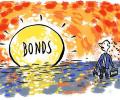
Banks looking to raise capital via bond sales to fund decade-high credit growth were compelled to put some of these debt issuances on hold amid a sharp rise in yields since late September, sources told Business Standard. A major private lender, Axis Bank, has not yet followed through with a planned issuance of infrastructure bonds worth around Rs 3,000 crore. This is because volatility in the bond market in late September led to investors seeking higher yields, sources said.
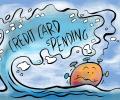
The outstanding credit card base dropped to 77.99 million in August from over 80 million in July, mainly on account of the new norms of the Reserve Bank of India (RBI) that warrant the deactivation of cards that are inactive for a year. While there was a 2.8 per cent decline in net card additions on a month-on-month (MoM) basis in August, a first in many months, credit card spends slipped 3 per cent on a high base. Still, spends topped the Rs 1-trillion mark for the sixth consecutive month.

Prism, the parent firm of global travel tech unicorn Oyo, has filed preliminary papers with market regulator Sebi to raise Rs 6,650 crore through an initial public offering (IPO) using a confidential route, people familiar with the development said on Wednesday.

All the BSE sectoral indices closed in the green. BSE Realty, Auto, Capital Goods and Industrials were lead gainers, jumping up to 5 per cent. IndusInd Bank was the lead gainer among Sensex shares, surging by 6.84 per cent. Tata Motors rallied 4.50 per cent. Larsen & Toubro, Axis Bank, Adani Ports, HDFC Bank, ICICI Bank and HCL Tech were also among the gainers. ITC and Hindustan Unilever were the only laggards.

Investors' wealth on Monday surged Rs 4.21 lakh crore as markets bounced back after five days of fall. The BSE Sensex jumped 602.75 points or 0.76 per cent to settle at 80,005.04. During the day, it surged 1,137.52 points or 1.43 per cent to 80,539.81.

Among the 30 Sensex companies, Axis Bank, HDFC Bank, ICICI Bank, Kotak Mahindra Bank, IndusInd Bank, State Bank of India, Infosys, Wipro, Tech Mahindra and HCL Technologies were the gainers. On the other hand, Titan, Maruti, Bharti Airtel, Larsen & Toubro, NTPC, Reliance Industries, Bajaj Finance and Power Grid were among the laggards.

Kaizad Bharucha, executive director of HDFC Bank, emerged the highest earning banker for 2021-22 (FY22). This was revealed in a remuneration assessment of the country's top bankers, according to annual reports. Bharucha, who oversees wholesale banking at HDFC Bank, received Rs 10.64 crore remuneration in FY22, mainly due to Rs 4.46 crore as performance bonus. Although earned between 2017-18 and 2020-21 (FY21), the bonus payout was partly paid in FY22.
These have always been pro-cyclical bets but new banks could erode RoEs.

Benchmark indices gained for the third day running on Friday, with the Sensex climbing over 300 points amid mixed global market trends. The 30-share BSE benchmark advanced 303.38 points or 0.56 per cent to settle at 54,481.84. During the day, it jumped 448.68 points or 0.82 per cent to 54,627.14. The broader NSE Nifty went higher by 87.70 points or 0.54 per cent to end at 16,220.60.

ICICI Bank was the top gainer in the Sensex pack, surging nearly 3 per cent, followed by HDFC, Axis Bank, Sun Pharma, NTPC and M&M. NSE Nifty surged 119.75 points to 15,812.35.

Banks say they themselves red-flagged the transactions to RBI. It must be noted that these transactions are not outright evidence of fraud or proof of nefarious activities.

SBI rose 2.43 per cent, Maruti gained 2.38 per cent, Sun Pharma 1.87 per cent and HUL was up by 1.78 per cent.

Bajaj Finance was the top loser in the Sensex pack, shedding around 3 per cent, followed by UltraTech Cement, NTPC, Axis Bank, ICICI Bank, IndusInd Bank, Reliance Industries, L&T and HDFC Bank. NSE Nifty slipped 38.95 points to 14,834.85.

Tata Steel was the biggest loser in the Sensex pack, sliding 8.59 per cent, followed by Tata Motors, Larsen & Toubro, Adani Ports, IndusInd Bank, Tech Mahindra, Reliance Industries, Sun Pharmaceutical, HCL Technologies, Tata Consultancy Services, Infosys, and NTPC, were the major laggards. On the other hand, Bajaj Finance, HDFC Bank, Nestle India, ICICI Bank, ITC, Asian Paints and Axis Bank were among the gainers.

From the Sensex pack, Tata Consultancy Services and Infosys fell over 2 per cent each. Hindustan Unilever, Bharti Airtel, Sun Pharma, Power Grid, Bajaj Finserv, HCL Tech, Mahindra & Mahindra, and Tech Mahindra were also among the laggards. Among the gainers, Zomato jumped nearly 5 per cent. Larsen & Toubro, Axis Bank, ICICI Bank, IndusInd Bank and Kotak Mahindra Bank were also among the gainers.

Losers included Bharti Airtel, SBI, Wipro, Vedanta, Maruti Suzuki, ICICI Bank, Axis Bank and Reliance Industries, falling up to 2.18 per cent.

Among the Sensex firms, NTPC, Power Grid, Reliance Industries, Bajaj Finserv, Axis Bank, Tech Mahindra, ICICI Bank, Bharti Airtel and IndusInd Bank were the biggest gainers. JSW Steel, Mahindra & Mahindra, Tata Steel, UltraTech Cement, Infosys and Titan were among the laggards.

To educate customers on the modus operandi of financial fraudsters and share inputs on safe banking habits, banks are now coming up with awareness campaigns aimed at preventing customers from falling into the trap of fraudsters.

Unlike in the past, when old private banks compromised upon underwriting standards to take on the bulk, they've now realised that scaling up at the cost of quality isn't worth the while. These banks have also readjusted growth targets when required, and rebalanced books to preserve capital and asset quality.

Among the 30 Sensex firms, ICICI Bank, State Bank of India, Axis Bank, Mahindra & Mahindra, Infosys, Larsen & Toubro, Tata Steel, Tata Consultancy Services, Bajaj Finance and Adani Ports were the major laggards. Asian Paints, Hindustan Unilever, UltraTech Cement, Sun Pharma and Reliance Industries were among the gainers.
From the Sensex pack, Bajaj Finserv, Mahindra & Mahindra, Axis Bank, Bajaj Finance, Adani Ports, ICICI Bank, Zomato and UltraTech Cement were among the biggest gainers. However, ITC, Nestle, State Bank of India, Reliance Industries, Asian Paints and Tata Consultancy Services were among the laggards.
